Accommodation
City hotels
Nairobi boasts some top quality hotels
As in any other large capital city in the world, Nairobi bears a rich and diverse range of accommodations. If you travel on a package safari you will probably spend no more than one night in the city, and you will be taken to one or another of the large chain hotels, all of them with good quality standards. Fortunately, the massive concrete, metal and glass blocks so extended in the western world are rare in Kenya and they are only found in downtown Nairobi, where they are mostly used by business travellers.
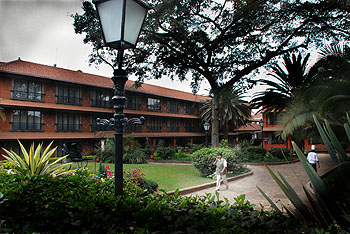 Some of the hotels in Nairobi are a part of Kenya's colonial history, like the somewhat unattractive Sarova Stanley, one of the leading 5-stars where nothing seems to remind of the oldest luxury hotel in town, founded in 1902. A better evolution was designed for The Norfolk, now belonging to the Fairmont group. Established in 1904 and almost concealed in a tranquil setting in the heart of Nairobi, its refurbishments have not annihilated the original tudor style and the anglokenyan charm.
Out of Nairobi, beach and golf resorts can be found along the coast. Many of them are right at the beach and have swimming pools and tropical shaded gardens. Some of them, like Serena Beach near Mombasa, recreate the traditional Swahili building style with whitewashed low buildings and wooden balconies.
Far from major towns, the only high quality accommodations take a different concept in the shape of safari lodges and tented camps, but there are almost no good standard hotels.
The main hotel & lodge chains in Kenya are Serena, Sarova and Sopa. International chains like Fairmont, Intercontinental, Hilton or Crowne Plaza have their quota, sometimes through the purchase of previously existing hotels, which in Kenya seem to change of hands quite frequently.
Lodges & clubs
The most popular kind of accommodation for safari
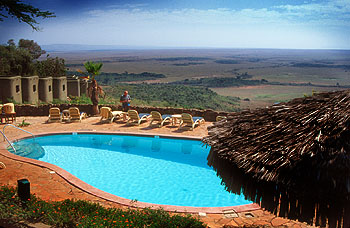 Out of the cities, lodges are the most usual accommodations for safari. They normally consist of a common area hosting the front desk, restaurant, lounges and shops, plus an array of bungalows or cabins housing the guests' rooms. Most of them have a swimming pool and broad gardens. The style ranges from the English cottage to the Maasai enkang. Normally they are located at magnificent spots, within or close to the parks or other spots of interest, and many of them overlook a waterhole visited by wildlife. Lodges offer full hotel service, including laundry. They are always booked on a full board basis.
If you are travelling on your own and staying at lodges, there is something you need to know. Since lodges are booked on a full board basis, and package groups always leave early in the morning to reach their next destination for lunch, the usual deal is that all guests are supposed to have lunch on the day of their arrival and only breakfast on the day of departure. If you wish to do a different thing, for instance arrive in the evening and have lunch boxes prepared for you on your day of departure (which I usually do), you definitely must specify it beforehand (e.g. when making your reservation). Otherwise you may be denied the right to lunch on your departure day. Did I already mention that independent travellers are not warmly welcome in Kenya?
Some lodges in Kenya have a special type of regime. They are mountain lodges, like Treetops and The Ark, both at the Aberdare National Park. Originally built as wildlife lookouts beside a waterhole, they are conceived to spend the night watching the animals that come by attracted to the water and mud ponds, and to the salt spread on the ground by the staff. In case you prefer sleeping, the small cabins are equipped with a buzzer that the employees will ring if some unusual animal shows up, mainly big cats and rhinos. Don't worry, you can turn the buzzer off if you still prefer sleeping. Due to the small size of the cabins and facilities, luggage is restricted to one hand bag per person. The rest of the luggage remains overnight at the base hotel outside the park.
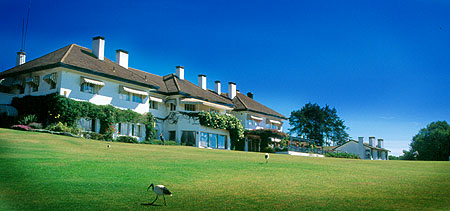 Clubs are halfway between hotels and lodges. They are former private clubs from the colony days which have been subsequently opened to the general public. They are located in large estates and usually have golf facilities, tennis courts, swimming pools and other amenities like horse riding. Some of them even have private wildlife reserves. Two well-known examples are the Mount Kenya Safari Club (now belonging to the Fairmont group), which was co-founded by actor William Holden and hosts an animal orphanage, and the Aberdare Country Club, the base hotel for The Ark.
Along the years, some settlers' estates have been opening their doors to the public. They are private wildlife reserves in which the owners build lodging facilities or even use their former homes to house guests. Many of them are so highly priced that they are exclusively targeted to the rich and famous. Some can be found along the shore of Lake Naivasha, the former haunt of the 'Happy Valley' set back in the heyday of the colonial rule. Two bright examples are elephant conservationist Iain Douglas-Hamilton's Olerai House, and Hippo Point and Dodo's Tower at the settlers family Cunningham-Reids' Nderit Estate, a unique place with the almost surreal sight of its wooden eight-storey spike overlooking Lake Naivasha. The latter is such an exclusive place that access is only by invitation --even its website is password-protected! Another example, but farther north in the rough landscape of the Laikipia plateau, is Mukutan Retreat and Makena's Hills, a pair of exclusive resorts set in Ol Ari Nyiro, the ranch of famous italian-born writer and conservationist Kuki Gallmann ('I dreamed of Africa').
Tented camps
The ultimate safari luxury
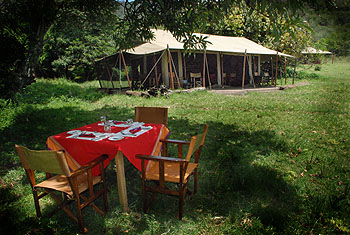 "Oh my God, we will be sleeping in a tent! Isn't that dangerous?". Safari novices are sometimes surprised when they find that something called a "tented camp" has been booked for them, even though they are spending good money on their vacation.
Don't be fooled. Tented camps are the ultimate safari luxury. They are similar to lodges in conception, except that sleeping is not in cabins or bungalows, but in full-fledged fixed wooden-poled, walk-in canvas tents recreating the luxury hunting safaris of the good old great white hunters. Tents have a bedroom, a full bathroom and sometimes even a lounge. Better than tents, they are actually canvas chalets. Most are permanent, but some are assembled only for the high season.
Many of them offer full hotel service, while others are more on the rustic side with bucket showers and no electricity. Here you pay for exclusivity, privacy, and nearly for your (temporary) own piece of Africa. There is a range of categories and prices, but some of the most luxurious accommodations in Kenya are tented camps. A good example is Finch Hattons in Tsavo, honouring the aristocrat and hunter who befriended famous author Isak Dinesen / Karen Blixen ('Out of Africa').
Campsites
The best way to travel on a budget, but it's not for everyone
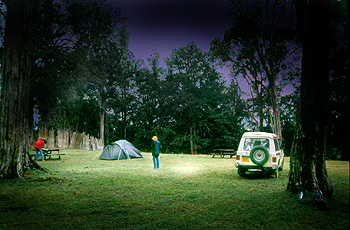 Safari camping is not only the best way to go for those travelling on a budget. It is also a unique experience, but maybe not for the weak-hearted. After dining your campfire-cooked rice or pasta sitting on a log and while you try to get to sleep tucked inside your bag, you will notice that only a thin layer of canvas sets you apart from a whole legion of mystery creatures grunting, roaring, snoaring and squeaking. You are all alone at night in the midst of the African bush, and there is no electric fence to protect you from lions or snakes. How's that for a thrill?
Still, all this is what makes the experience of camping in Africa an unforgettable one. Don't worry, you're safe. Wildlife incidents affecting campers are almost unheard of in Kenya. Animals know which is their place and which is yours. You will have a vibrant nocturnal serenade as your lullaby, and that's all.
Actually, if you are planning to camp, the only creatures that could possibly threaten your sleep are two-legged. Should I remind you that Kenya can be a dangerous place in what concerns crime, and a solitary tent in the middle of nowhere is an easy prey for human predators. So, never ever think about camping in the open countryside out of national parks and reserves, and even in these do it only at authorised campsites.
There are two types of campsites. In public campsites the grounds are shared by all campers and there is usually access to water and latrines. Public campsites need not be booked in advance. Conversely, special campsites have no facilities whatsoever and must be booked on an exclusive basis. These sites are mainly conceived for package camping safaris, in which groups travel in a truck with their own cook and carrying all the gear, supplies and food. Special campsites should be booked in advance through Kenya Wildlife Service (KWS).
All that said, camping in Kenya's parks is cheaper than lodge accommodation, but not 'that' cheap. For public campsites, daily rates for non-residents are currently USD 25 for adults and USD 20 for children (3-18 years) in Amboseli and Lake Nakuru National Parks, and USD 15 for adults and USD 10 for children in all other parks managed by KWS. For special campsites, daily rates are USD 40 (adults) and 20 (children) in Amboseli and Lake Nakuru, and USD 30 (adults) and 15 (children) in all other parks, plus a special campsite weekly reservation fee of KSh 7,500. You can find more details on tariffs here.
Note that these rates and conditions are only for parks managed by KWS. Most places designated as National reserves such as Masai Mara and Samburu/Buffalo Springs are not under the governance of KWS but of their respective county councils, so different conditions may apply. Sadly, they usually stick to the same escalating fees policy of KWS.
Apart from campsites, in most parks there are picnic sites with some benches and shelters, but with no cooking facilities.
For a couple of tips on camping gear, read the "What to pack: safari gear" section.
Self-catering bandas
A very convenient intermediate solution
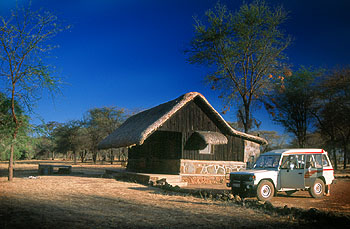 If you are travelling on a budget and don't mind doing your own cooking, but you'd rather have a bed, flush toilet, running water, even perhaps some electricity, and four solid walls around you, then self-catering bandas are your choice. However note that these are not luxury accommodations, just basic facilities, and that prices are not precisely a bargain, but still they are more economic than lodges.
Parks managed by Kenya Wildlife Service usually have several self-catering bandas consisting of a house or bungalow with one or more bedrooms, bathrooms, kitchen and lounge. In some cases there may be various cabins with a common mess area. Kitchenware, crockery and bed linen are provided, and there's a caretaker who will keep the basic maintenance. Each unit (being a house, block or group of cabins) must be booked in full. They have varying capacities and number of bedrooms, but they are mostly conceived for families or groups of friends travelling together.
You will find the full list of KWS self-catering bandas here, and the rates here. Bandas can be booked by email to reservations@kws.go.ke, but be sure to do it well in advance, since they can take quite a long time to reply. You will be asked for a 50% deposit, which you can pay by bank transfer. You can read the full terms and conditions here.
|


 Español

