Parks & reserves: Masai Mara National Reserve
Managed by: Local counties
Safari Card: Masai Mara specific smartcard required (read more)
|
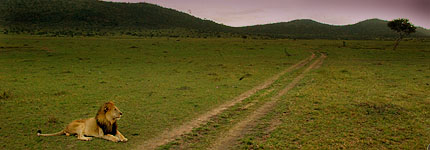 A lion on a plain near Sand River. J.Y./Kenyalogy.com
|
General info
Whenever you think of Kenya and you've never been there before, what you're thinking about is Masai Mara (also spelled Maasai Mara). This is THE park of parks in Kenya. Its grass-carpeted smooth rolling hills, the chocolate waters of the Mara boiling with frolicking hippos, and the teeming wildlife, all of it fulfills the expectations of any visitor longing for the African landscapes portraited in "Out of Africa" or "Mogambo".
Except for particular tastes or special requirements, this is the park on top of the 'must' list in the country: no trip to Kenya would be complete without a visit to Masai Mara. It's true that some animals like leopards and rhinos may not be easily found, at least by one's self, and that keen birders may quell their thirst better elsewhere. However, leopards and rhinos are well represented, and with more than 450 bird species, the reserve should not be envious of Samburu or the great Kenyan bird sanctuaries. Albeit, in an area only slightly smaller than the State of Rhode Island and with a diverse ecogeography, getting lost is far easier than spotting a leopard or a particular bird species in its numerous wooded areas.
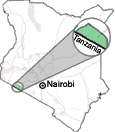
The reserve, gazetted in 1961, is located west of the Rift Valley and is a natural extension of the Serengeti plains, in Tanzania. The Mara river, the reserve's backbone, travels north to south heading for its westbound way unto lake Victoria, through the Tanzanian park. This course is the natural barrier crossed every year by the large migratory herds of wildebeests and zebras that trek across the two parks. More than one million wildebeests and 200,000 zebras move in a quest for the best pastures, stomping into crocodile-infested riverbanks along their way. When the herds wade across the stream, many animals die trampled or drowned, and their foul-smelling carcasses attract a crowd of vultures and other scavengers that feast on the decaying remains as if there was no tomorrow. From July to October, Masai Mara is in its full wild glory.
The reserve's location and elevation, above 1,500 m, provide a climate that is milder and damper than in other regions. The grassy landscape and the nutrient wealth for the great herds are mantained by the abundant rains, which here last from November through June, merging the two rain seasons (long and short) typical in other areas of the country. Still, even off-season you may get caught by flash showers, and night storms are frequent.
In the hills and plains, grasslands are scattered with acacia woods and bush. The riverbanks of the Mara and of the tributary streams are fringedby dense riverine forests that offer a good chance to find some of the reserve's bird life.
The long distance to the country's main urban centers poses a difference that allows this reserve to keep one of the features which is becoming today an oddity in African parks: wildlife roams in complete freedom, without fences or other obstacles around. Animals have never heard of the borders drawn on the papers, not only those which split Kenya from Tanzania but the limits of the protected area as well. The reserve is surrounded by dispersal areas, community ranches inhabited by the Maasai but otherwise similar to the territory within the limits, with equal or even higher opportunities to spot wildlife than at the reserve itself which is frequently overcrowded by tourists wandering about in minivans, four-wheel-drives and balloons.
Masai Mara is not managed by Kenya Wildlife Service but by the local authorities, namely Narok County Council (east of the Mara river) and Trans Mara County Council (the area called Mara Triangle, west of the Mara river, managed on behalf of the county council by the not-for-profit Mara Conservancy). This apparently irrelevant fact is not so: entry fees are paid to one or other local authority depending on your point of access, and at least you are bound to exit the park through the same sector you used for entry. Besides this, whether you are allowed to cross to the other side without paying double fee remains a controversial issue. There is only one place for doing so, the Mara bridge on the south, just by the Tanzania border, and there is no formal checkpoint there. In one occasion, a drunk Trans Mara 'sheriff' threatened me because I had entered via Narok and I was sleeping at the Triangle. So just in case, keep this in mind.
And in this wildlife webwork, where do the Maasai fit? The nomad pastoral tribe, formerly feared because of their warrior power, inhabits these lands from old. When in 1911 chief Lenana signed an agreement with the colonial government, he accepted selling the Maasai's territories and moving southward, for the sake of Nairobi's urban development. But the Masai Mara region had already been deserted over the 19th century, when epidemics and tribal warfare decimated the Maasai people and drove them to a decline which they are still expecting to recover from. Thus, an ancient Maasai prophecy which forecasted the arrival of the foreigners also foresaw a future that would bring back the old splendour days.
When the reserve was inaugurated, in 1961, it was done as to protect animals in a deserted and wild country, in which wildlife was coming to an end due to massive killings committed by white hunters. The protection of this area, among other factors, favored repopulation of the territory by the Maasai, who by virtue of the reserve status were put in charge of the reserve's management through the District Councils. Though land conflicts are still about, the chosen formula for preserving this natural space attempts to render some reward to the Maasai by means of managing group ranches, trading with tourists and admitting visits to their villages. All of it provides a permanent income source.
The Maasai's aspect and legend has made them become a mythical tribe with a romantic aura. The truth is that the Maasai struggle between their classical conservationism and the temptation to join the ranks of industrial revolution seeking a more buoyant life. Their tendency to take a grip on tradition has granted them sympathy and admiration from tourists longing for picturesque scenes, but also rejection from the more progressive Kenyans, who believe that a nomad pastoral tribe in the 21st century's global economy is condemned to poverty. Today, many Maasai customs are restricted by law, such as lion hunting, while others like traditional nurturing on blood and milk fall into oblivion and become little more than a staged show for tourists.
Meanwhile, visitors expect to find a taste of an unspoilt real African tribe in a safe and peaceful country, devoid of poaching, with no cattle in the reserves and without muggers. An impossible combination, unless condemning the Maasais to become employees of a theme park, wearing their shukas and spears while tourists hang around and then switching to their sweaters and long pants when the wazungu leave. Some of this can be seen in the pierced ears of many lodges' waiters and cooks.
|


 Español