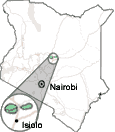
Parks & reserves: Samburu, Buffalo Springs & Shaba National Reserves
 Managed by:
 Local counties
Safari Card: No
|
 Elephants crossing the Ewaso Nyiro river. J.Y./Kenyalogy.com
|
General info
The reserves complex formed by Samburu, Buffalo Springs and Shaba is one of the most interesting places in Kenya and can be ranked as unique for several reasons. They are the most accessible and visited of the protected areas in the country's rough north, right at the edge of what was formerly called Northern Frontier District (NFD). Or, in other words, they are the most remote among the most popular reserves. It is also the place to see some species which are rare in Kenya or difficult to spot in other parks, like Grevy's zebra, reticulated giraffe and beisa oryx.
Unfortunately, these reserves are also the most blatant example of how Kenyan authorities try to empty your wallet in all imaginable ways. Samburu and Buffalo Springs are adjacent reserves, separated only by a river that can be easily crossed through a bridge some 3 km upstream Samburu Game Lodge. But it turns out that the river is also the border between two different counties, Samburu and Isiolo. And obviously, there seems to be no way for both of them to profit from tourist revenues other than charging separate entry fees. Therefore, if you wish to enjoy the full ecosystem from both river margins, you have to pay double, so most visitors just remain at the side of the river where their lodge is.
In my own experience, if you approach the rangers at the bridge gate with a smile and a polite attitude, you may be allowed to cross the river for a game drive on the other side, but do not count on it. In the case of Shaba, it is close to Buffalo Springs and belongs to the same Isiolo county as the latter, so entry tickets are valid for both.
The frontier condition assigned to this region also refers to the traditional problems with the Somali guerrillas that occur from time to time north of this area. Little after the gazetting of the reserves, in the 1960's-1970's, they remained closed for several years due to continuous attacks by the rebels. Albeit this and the more recent safety problems infamously staged by some rangers, visiting these reserves is a must within the basic itinerary.
Initially, Buffalo Springs covered both banks of the Ewaso Nyiro river (Uaso Ngiro, 'Dark Waters') along 16 km, but later on, the northern bank was torn apart as an independent reserve following the district (currently counties) demarcations. Both counties, Samburu ('butterfly' in the local Maa language) and Isiolo belong to different provinces, Rift Valley and Eastern respectively.
Shaba, the less visited of the three, is also the largest, with a total extension of 239 km². Samburu and Buffalo Springs are similar in surface, 165 km² the first and 128 km² the second. The area has been traditionally inhabited by the Samburu people, a nomad paranilotic tribe closely related to the Maasai.
The Samburu complex landscape anticipates what the traveller should expect if he sets his feet for the northern territories, hence its classical "frontier" epithet: arid thornbush savannah, scrubland and scattered acacia. The dusty plains are broken by smooth hills such as the Koitogorr uplift in Samburu (1,245 m), and lying far beyond, the flat head of the reddish Ol Olokwe mountain. The extreme heat, in spite of the elevation which at many locations exceeds 1,000 m, and the landscape desolation, are paramount ingredients of Samburu's particular charm: it is the face of the less hospitable African landscape. At first sight, these reserves could suggest a wildlife desert. Actually, this arid scrub is the preferred habitat for some mammals that make their homes in this harsh and unfriendly environment, some of them quite rarely seen in milder climates.
Most of the wildlife never gets too far away from the scarce wet areas, mainly the forested banks of the Ewaso Nyiro, which brings the water from the Aberdare mountains, and the crystal clear Buffalo Springs, which give name to the reserve and arise from underground streams coming from Mount Kenya. The humid spots support a more luxuriant vegetation, with the prehistorical-looking bi-branched doum palms, riverine forests and grasslands. The high faunal concentration at the waterholes and streams is a gift for the wildlife watcher, while animals also seem to amuse themselves staring at tourists that try a dip in the artificially built Buffalo Springs pools.
Beyond Samburu and Buffalo Springs, the river heads on licking Shaba's north border. This place takes its name from a volcanic cone that protrudes upon the plain where a lava flow is crossed by the road. Beyond Shaba, the river wanders about down to Chanler's Falls, to finally die in the Lorian Swamp. Shaba's landscape is seeded with low hills and its four natural springs make it a much wetter place than its neighbouring reserves, to such an extent that during the rains Shaba's tracks are only open to 4WD vehicles. In general, the reserve is less developed and is therefore more peaceful and solitary than the other two.
Shaba is known for being the place where in 1980 poachers murdered Joy Adamson, the author of 'Born free'. At the time of her death, the famous conservationist was engaged in a project aimed at reinserting hand-reared leopards to the natural environment.
|


 Español