Parks & reserves: Arabuko Sokoke Forest Reserve

 Managed by:
 KWS
Safari Card: No
|
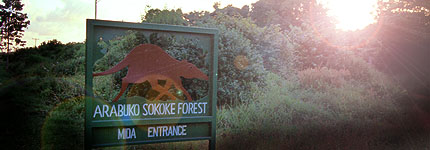 Arabuko Sokoke Forest Mida entrance. J.Y./Kenyalogy.com
|
General info
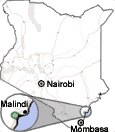
This tiny forest reserve in Kilifi district, with only 6 km², is a small part of the largest stretch of indigenous coastal forest that survives today in East Africa. The Arabuko Sokoke forest, with 358 km², settles in the region from north of Kilifi to Gedi, south of Malindi, and inland toward the town of Jilore. The forest preserves the landscape that formerly covered all the strip adjacent to the shore line of the Indian Ocean. This jewel of nature has been declared the second most important forest in Africa for bird conservation, and is currently under consideration for the rank of World Heritage Site.
The treasures in this forest were already appreciated during the Colony days, when the place was declared Reserve of the Crown. In 1977 it was further protected as a Forest Reserve, and in 1991 a small part was ranked National Park, mainly to protect two rare mammal species bordering extinction, the Ader's duiker and the yellow-rumped elephant shrew, as well as six bird species.
When the park was gazetted, in 1991, native residents were largely dissatisfied, since the forest was a block to the agricultural development of the land resources that could perhaps help relief the region's battered economy. A survey revealed that 96% of the locals was unhappy with the presence of the forest and a 54% supported its complete elimination. Land hunger, scarce availability of resources and crop raid by wildlife posed an uncertain furture for a world unique natural space.
Initiatives undertaken since then have made the Arabuko Sokoke forest one outstanding model of sustainable development. Aiming at the balance between forest resources utilization and conservation, the Forest Department and Kenya Wildlife Service joined to launch the Arabuko-Sokoke Forest Management Team (ASFMT). The goal of this group is to avoid the abuse of forest stretches for shortsighted uses on behalf of local communities, pursuing at the same time a role for the forest as a booster of the region's economy. On the other hand, the Kipepeo Butterfly Farm Project has relaunched domestic economy in such a way that, in 1998, a new survey revealed that 84% of the locals supported forest conservation.
Together with the neighbouring Mida Creek, Arabuko Sokoke hosts a large biological diversity, with plenty of rare species of birds, butterflies, amphibians and plants. The region's trees have traditionally supplied the local communities with firewood, medicines, poles, timber and carving wood.
For further information, ask for the Forest Department's 'Arabuko Sokoke Forest and Mida Creek, The Official Guide'.
|


 Español