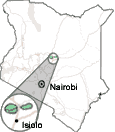
Parks & reserves: Samburu, Buffalo Springs & Shaba National Reserves
Wildlife
At these reserves it is easy to find some of the species that live only above the Equator and that therefore you will very hardly spot in southern parks. Among them you will find Grevy's zebra, distinguished from its plains' relative by narrower stripes and big rounded ears. Oddly enough, some plains' zebras (Burchell) are also found mainly at the south banks, in Buffalo Springs, but they do not seem to interbreed with their Grevy's cousins.
The beisa oryx is a beautiful grey antelope, with black and white marks in the face and long horns in both sexes. The reticulated giraffe, with no mistake the most gorgeous in the family, is easily distinguished by its particular coat, a thin and clear white net splitting the orange spots. Another remarkable inhabitant of these reserves is the gerenuk, a slender antelope with thin neck and long legs that drinks no water and feeds on the acacia's leaves, supporting its body on the hind legs.
Samburu and Buffalo Springs host basically two different environments for wildlife observation. The first one holds all the arid plains, far off the water sources. Relatively few animals inhabit these lands on a permanent basis, outstanding the oryx, Guenther's dik-dik (in addition to the more widely extended Kirk's), gerenuk, eland and impala. These species are little water-dependent and may be found in the scrublands during the day, sheltered beneath a tree shade.
Conversely, the rest of herbivores, including zebra, giraffe, elephant, buffalo, warthog, waterbuck, Grant's gazelle and bushbuck seek the fresh and shaded riverbanks during daylight, leaving them at dusk. The great advantage for the watcher in Samburu and Buffalo Springs is that driving along the river gives the chance to see a huge lot of animals close at hand. Waters welcome their permanent dwellers, hippos and crocodiles, while up its big trees and doum palms roam the vervet monkeys and baboons.
Carnivores are well represented in the Samburu complex. Lions and cheetah traverse the dry areas and seek the shaded riverine forest for a drink and a rest. Hyenas, including the striped of nocturnal habits, travel long distances with their light trotting. But one of the reasons that has made these reserves so popular is the real good possibilities to catch a sight of the leopards, much more probably than in any other Kenyan park. These felines are found elsewhere, but their taste for the high branches helps them to pass unnoticed most of the times. Here, leopards rest and kill by night at the Ewaso Nyiro banks. An early morning drive, when the cats are still active, has a great chance of reward.
The three reserves are also the haunt for a rich bird life, with more than 300 species recorded. This is the place for the Somali ostrich, with its bluish neck and thighs, and for the Kori bustard, standing a meter high. The scrublands are home for some game birds, like crested francolins, yellow-necked spurfowls and the Guineafowls, both vulturine and helmeted that actually belong to different genuses and that flock to drink down at the river banks. Red-billed hornbills, marabou storks and superb starlings are a permanent presence. Prey birds include eagles, owls, kites, goshawks and sparrowhawks. Woodpeckers nest in the riverine trees. The Ewaso Nyiro waters attract a great deal of water birds, like pelicans, herons, hamerkops and kingfishers.
Finally, on the banks around the river you may see some small dust puffs like tiny sand geysers rising from holes in the ground. These are the burrows of naked mole rats, rare and small mammals devoid of hair, with a social behaviour similar to colonial insects. Their presence can be detected through the mounds resulting from their tunnel excavations.
|


 Español