Parks & reserves: Masai Mara National Reserve
Access
Very Important note: In order to curb corruption in the collection of park entry fees, the Narok County Council introduced in 2011 an electronic payment system managed by Equity Bank and akin to the Safari Card used in parks managed by Kenya Wildlife Service. The move sparked serious riots at the park gates, allegedly staged by those who were unlawfully profiting from park fees. The future of the system is yet to be determined. But for the moment, if you are travelling to the Mara, you must get a smartcard beforehand at one of the Equity Bank branches, located at Mombasa Road, Westlands, Equity Centre, Harambee, Moi Avenue, Karen, Mama Ngina (all of them in Nairobi), Changamwe (Mombasa), Moi Avenue (Mombasa), and Narok (this one is the closest to the reserve). This is even one more fatal blow for the independent traveller in Kenya.
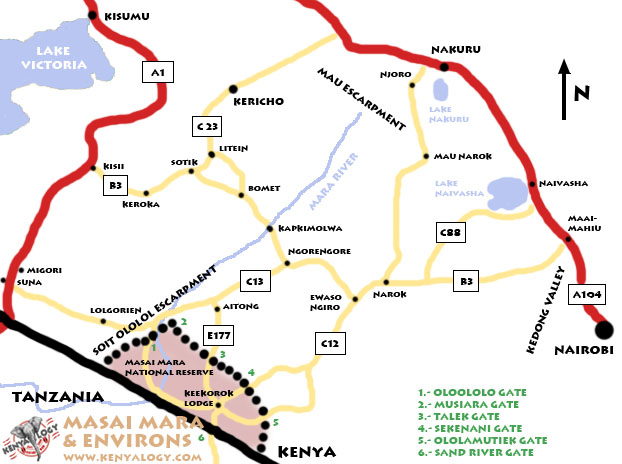
Masai Mara is located 270 km west of Nairobi, at a remote southwestern corner of the country, right at the edge of the Tanzanian border. The optimal route in each case will depend not only on your place of departure, but also on your destination, since for administrative reasons explained under "General info", you are supposed to enter the reserve through a gate at the sector where you will be sleeping (east or west of the Mara river), and you are supposed to visit only that sector.
Concerning entry fees, they are currently USD 70 per day for non-residents staying within the reserve, and USD 80 in case of sleeping in one of the adjacent private conservancies or group ranches (check the updated fees here). Entry fees have been escalating over the past years with no apparent limit, and they have more than doubled in just five or six years. As mentioned elsewhere on this site, this money-grabbing mania of Kenyan authorities, which is frequently disguised with the argument that Masai Mara is severely overcrowded with tourists, will probably keep on until the day when travelling to Botswana, Namibia or South Africa will be cheaper than travelling to Kenya, and then tourists simply will go somewhere else. Needless to say, Masai Mara is in fact overcrowded, specially the Narok (east) area, but surely some solutions could be found to this other than restricting the enjoyment of this natural wonder only to the wealthiest.
Whatever your route, roads to Masai Mara range from acceptable to abominable, and they can be even worse after heavy rains. Buses only reach the town of Narok, still far off the reserve. Because of this, many visitors choose to travel by air. Air Kenya and SafariLink cover the various strips within and near the reserve. Some lodges cater specially for visitors arriving by plane and provide transport to/from the lodge plus vehicles for the game drives.
The following paragraphs explain the routes by road from the most usual points of departure. Many of them converge in the B3 road, which runs east-west in parallel to the Tanzanian border and is the starting point for several roads down to the reserve.
From Nairobi
Don't be deceived by the 270 km distance from Nairobi: it will take you some five or six hours just to the eastern side of the reserve, to which you should add -if this is your case- the driving time within the limits. In Nairobi, take the A104 road toward Naivasha and Nakuru. After passing the Kikuyu Escarpment, holding your breath with the Rift Valley views and descending to the bed of Kedong Valley, at Maai-mahiu take the left turn-off toward Narok along the B3 road. Some 15-20 km past Narok, the road reaches Ewaso Ngiro, where there is a crossroads. From here there are two possibilities for accessing the reserve:
Option A: this is the most frequent route, leading to the eastern sector of the park, where Keekorok Lodge is located. At Ewaso Ngiro, turn left to the C12. Some 40 km ahead the road divides. Both tracks lead to Masai Mara, but to different gates, and converge within the reserve at Keekorok Lodge. The one at the right is the main access, leading to Sekenani Main Gate. The left route reaches Ololamutiek Gate crossing a difficult stretch, but it is passable for a 4WD vehicle.
Option B: less used because of its worse conditions and mud abundance after the rains. At Ewaso Ngiro, go straight ahead along the B3 some 40 km more up to Ngorengore. At this town turn left to the C13. From here there are two further choices. The first one is driving straight to Oloololo Gate and Kichwa Tembo Camp, at the western side of the reserve. The second option is turning left at Aitong to the E177. This track leads to the eastern sector through Talek Gate.
From Naivasha
If you depart from Naivasha you have two main routes for reaching Ewaso Ngiro, from where the two options mentioned under "from Nairobi" apply.
Option A: take the main A104 road heading for Nairobi. At Maai-mahiu, turn right to the B3 towards Narok and Ewaso Ngiro. This is the preferred access because it uses a stretch of the main highway.
Option B: just south of the lake, take the right turn-off to the C88. This track crosses the Mau Escarpment and offers beautiful sights, but becomes heavily muddy during the rains. It finally reaches the B3, which you will take right heading for Narok and Ewaso Ngiro.
From Nakuru
The Nakuru case is similar to that mentioned for Naivasha. Basically there are two possibilities, one is more straightforward and scenic but more complicated, and the other one uses a stretch of the main A104 highway to Nairobi. Both routes reach Ewaso Ngiro, at the B3. From here the route is the same as in "from Nairobi".
Option A: take the main A104 highway to Naivasha. See "from Naivasha".
Option B: in Nakuru, take the road heading south to Njoro and Mau Narok across the Mau Escarpment. This track is a quagmire during the rains. The road finally leads to the B3 at Narok, then turn right to Ewaso Ngiro.
From the north (Kericho)
Take the C23 southward heading for Kisii and turn left at Litein to the paved road that covers some 40 km before reaching Bomet. Here, turn left to the B3. From this track you can drive down to Masai Mara taking the C13 at Ngorengore (some 40 km off Bomet) or either the C12 at Ewaso Ngiro, as explained under "from Nairobi".
From the west (Kisii)
Option A: take the main A1 highway heading south for Tanzania. Past Migori, at Suna, little before reaching the border, there is a left turn-off toward Lolgorien and Masai Mara. This track crosses the Soit Ololol Escarpment and is very steep in places. You will enter the reserve through Oloololo Gate, at the western sector (Trans Mara).
Option B: from Kisii take the B3 eastward to Keroka and Sotik. Head on along this road passing Bomet and Kapkimolwa to drive down the C13 from Ngorengore or the C12 from Ewaso Ngiro, as explained under "from Nairobi".
From Tanzania
If you plan to drive into Masai Mara from the Serengeti, note that the border crossing between Serengeti and Masai Mara at Sand River Gate has been traditionally closed. The Immigration Department's website now lists Sand River Gate as a recently opened entry point operating from 6:30 AM to 6:30 PM, but I haven't confirmed it by myself. If you are self-driving, check with your car rental company that you are allowed to cross the border. You will probably have to pay an extra insurance.
Moving around in Masai Mara
As said, it is important to consider where your lodge or camp is located, since you are supposed to remain in that area, whether it is the section east of the Mara river (Narok/Keekorok), west of the Mara (Trans Mara/Triangle) or outside the reserve (private conservancies/group ranches). For those who are in the latter case, note that Masai Mara is not fenced in, and therefore wildlife is as plentiful off the reserve limits as it is within.
Within the limits, the only communication between east and west across the Mara river is the New Mara Bridge, right at the south border of both the reserve and the country itself. The bridge is located on the reserve's main road, the E176, which connects Keekorok Lodge with Oloololo Gate. There is a second bridge over the Mara, but it lies outside the reserve, northwest of the limits shortly past Oloololo Gate.
Keekorok Lodge, where the E176 dies, is the main crossroads in Masai Mara. From here three roads branch off to Talek Gate (E177), Sekenani Gate (C12) and Ololamutiek Gate (E301), respectively. The C12 comes from Ewaso Ngiro and does not end at Keekorok, but it follows southward past the lodge to Sand River Gate, at the Kenya-Tanzania border.
Besides this main network, there is a web of minor tracks in different conditions, some of them passable all the year round and others flooded during the rainy season, specially at the northwest. Frequent off-road driving (which is forbidden) has drawn a tangle of wheel tracks that are hard to discern from the 'legal' roads. This, together with the fact that all available maps are far from accurate, makes a GPS essential for navigating in Masai Mara. Also, watch your fuel. Lodges usually have a filling station, so always try to start your day off on a full tank.
|


 Español